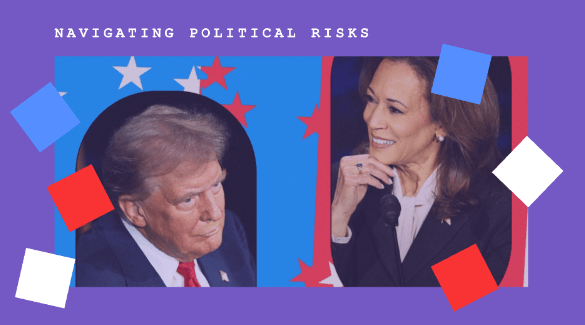
As the 2024 U.S. presidential election approaches, political risks for project finance are rising. Beyond regulatory shifts and tax changes, issues like protectionism, infrastructure funding, labor policies, and ESG considerations are becoming critical. Financial modeling needs to adapt to this dynamic landscape to ensure project resilience and profitability. 🚧
### 1. Advanced Techniques for Modeling Political Risks
Political risk modeling in project finance must consider a broader spectrum of uncertainties:
– Stochastic Scenario Analysis: Develop a range of probabilistic scenarios based on possible election outcomes and their impacts on regulations, tax policies, and trade measures. Use Bayesian updates to adjust probabilities as new election data emerges.
– Monte Carlo Simulations: Capture the probability distributions of key variables like tax rates, tariffs, and regulatory changes. Simulate thousands of iterations to provide a probability-weighted outcome for different political landscapes.
– Real Options Valuation: Quantify the strategic flexibility of deferring or altering project plans. For instance, analyze the option to delay investment until there is more regulatory certainty or to scale project capacity depending on the election result.
### 2. Key Political Risks to Monitor
#### Protectionism and Trade Policy Shifts
With a potential resurgence of tariffs or restrictive trade measures, project costs could rise, especially for those dependent on imported materials. Model different tariff scenarios, incorporating increases in supply chain costs and potential delays.
– Modeling Tactics: Combine sensitivity analysis and Monte Carlo simulations to forecast cost impacts under various trade policies.
#### Federal Infrastructure Funding Changes
Election outcomes will affect infrastructure funding priorities. A Trump administration might favor traditional infrastructure, while a Harris administration could prioritize green projects. This variation will directly impact the availability of federal grants and loans.
– Modeling Tactics: Use scenario analysis to explore different funding outcomes and their effects on financing structures, equity requirements, and debt terms.
#### Labor and Immigration Policies
Labor costs may fluctuate based on changes in immigration policy. Stricter controls could reduce labor supply and increase wages in construction and engineering sectors.
– Modeling Tactics: Develop dynamic labor cost models that consider changes in immigration policy, wage inflation, and labor shortages. Conduct stress tests to evaluate extreme labor constraints’ impacts on project schedules and budgets.
#### Environmental and ESG Risks
ESG factors are becoming increasingly important. Depending on the election outcome, we could see divergent paths—either a rollback of environmental protections or a strengthening of regulations, impacting project compliance costs and financing.
– Modeling Tactics: Integrate ESG risks into financial models, accounting for potential increases in capital expenditures, compliance costs, and penalties. Use real options analysis to assess the value of future investments in green technology or carbon offsets.
### 3. Preparing for Election-Driven Volatility
The 2024 election is poised to create significant market volatility. For instance:
– Scenario 1: Trump Presidency: Anticipate deregulation, tax cuts for traditional energy sectors, and a potential shift toward protectionist trade policies. This could reduce compliance costs but increase interest rate volatility and trade-related expenses.
– Scenario 2: Harris Presidency: Expect expanded green subsidies, stricter environmental regulations, and an emphasis on labor rights. Financial models should factor in increased compliance costs and changes in federal infrastructure funding priorities.
### Conclusion: Expanding Risk Management Strategies
To navigate the uncertainties surrounding the 2024 U.S. election, project finance professionals must broaden their risk models to include a comprehensive range of political risks, from protectionism to ESG dynamics. Advanced techniques like stochastic scenario analysis, Monte Carlo simulations, and real options valuation provide the tools needed to make data-driven decisions in an unpredictable environment.
 Finteam