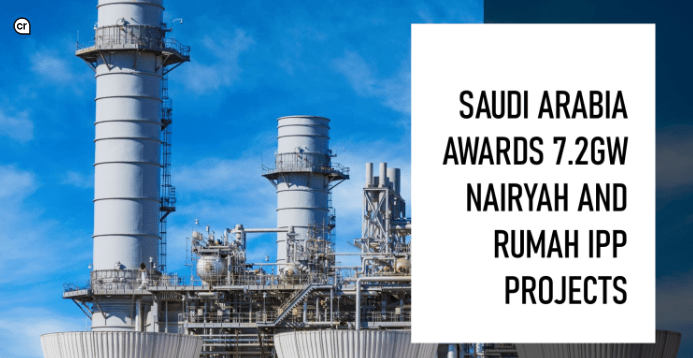
Saudi Arabia has announced the winning bidders for four major power projects—Rumah-1, Rumah-2, Al-Nairyah-1, and Al-Nairyah-2—totaling an impressive 7.2GW of capacity. This is a significant leap in the Kingdom’s efforts to diversify its energy mix and reduce dependency on liquid fuels, all in alignment with the Saudi Vision 2030. Let’s take a closer look at what these projects entail and their significance for the future of Saudi energy.
Winning Bidders and Project Details
The Saudi Power Procurement Company (SPPC) revealed the winning consortiums for the four projects, each of which will deliver 1.8GW of power, and all part of the Kingdom’s strategy to meet its growing electricity demand sustainably and efficiently:
- Rumah-1 Power Plant: Awarded to a consortium comprising Saudi Electricity Company (SEC), ACWA Power, and Korea Electric Power Corporation (KEPCO). SEC will serve as the managing and technical member of the group.
- Rumah-2 Power Plant: A second consortium consisting of Abu Dhabi National Energy Company PJSC (TAQA), JERA, and Al-Bawani won the contract. TAQA is taking the lead as the managing and technical partner.
- Al-Nairyah-1 Power Plant: The same consortium that won the Rumah-1 project—SEC, ACWA Power, and KEPCO—has also been awarded the Al-Nairyah-1 project.
- Al-Nairyah-2 Power Plant: The consortium led by TAQA, JERA, and Al-Bawani has also secured the contract for the Nairyah-2 power plant.
These projects will operate on a build, own, and operate (BOO) basis, with each project having a 25-year power purchase agreement with SPPC. The combined investment for these projects is estimated at around SAR 30 billion (USD 8 billion).
Paving the Way for a Sustainable Energy Future 🌱🔋
These projects are an integral part of Saudi Arabia’s energy mix plan, supervised by the Ministry of Energy. The goal is to balance renewable energy and gas in the Kingdom’s power production, with each contributing 50% of the mix by 2030. This approach is aimed at displacing liquid fuels and achieving a more optimal and sustainable energy composition for electricity production.
In line with the Saudi Green Initiative, these projects will play a role in reducing greenhouse gases (GHGs), adopting the circular carbon economy approach to achieve net-zero emissions by 2060 or earlier, depending on the availability of necessary technologies. The new power plants will utilize Class H/J Gas Turbines with high efficiency in Combined Cycle operation, and they will be built with readiness for carbon capture technologies. This enables Saudi Arabia to ensure that its energy production is cleaner and more efficient.
Local Content and Economic Contribution 🇸🇦💼
These projects are not only about meeting electricity demand but also about contributing to Saudi Arabia’s broader economic goals. The winning bidders are required to adhere to localization and local content requirements, contributing to the Saudi economy by promoting local industries and expertise. This is crucial for achieving the Saudi Vision 2030 goals, which emphasize diversifying the economy and building local capabilities in critical sectors like energy.
Impact on the Kingdom 🏘️🔌
The Nairyah and Rumah IPP Projects will have a massive impact on Saudi Arabia’s power grid, supplying electricity to approximately 3 million residential units annually. With SPPC’s commitment to deploying the latest technology and its focus on creating a balanced and sustainable energy mix, these projects are a cornerstone of the Kingdom’s drive to secure its energy future.
A Key Milestone in Saudi Arabia’s Energy Landscape ⚡✨
Saudi Arabia’s decision to award the contracts for the 7.2GW Nairyah and Rumah projects underscores the nation’s commitment to an ambitious and sustainable energy vision. By balancing natural gas and renewables, the Kingdom is not only setting a path towards net-zero emissions but also creating economic opportunities and enhancing the resilience of its energy infrastructure.
What do you think about Saudi Arabia’s approach to diversifying its energy mix and reducing emissions? Let’s connect and discuss how these ambitious projects are reshaping the future of energy! 💬🌍
 Finteam