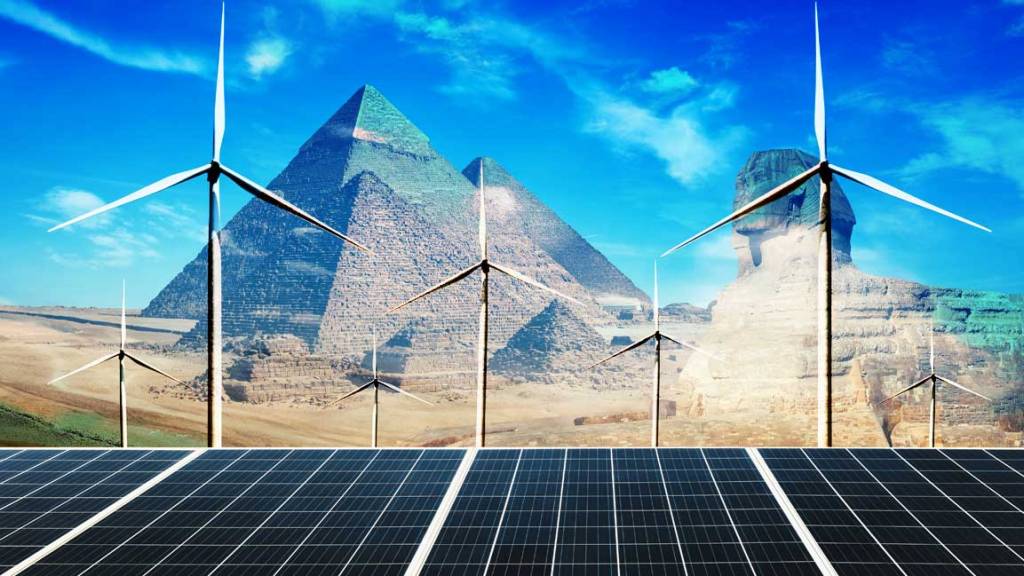
Egypt is positioning itself at the forefront of the renewable energy movement in North Africa, with plans for mega-scale projects that will significantly boost the country’s renewable energy capacity. Alcazar Energy Partners, a Dubai-based renewables developer, and Voltalia, a French renewable energy company, have announced ambitious plans to develop more than 5 GW of combined solar and wind projects in Egypt. This strategic move aligns with Egypt’s goals to diversify its energy mix, reduce greenhouse gas emissions, and support economic growth. Let’s dive into the key projects announced and what they mean for the country’s renewable energy landscape.
Alcazar Energy’s Onshore Wind Ambition 🌬️
Alcazar Energy Partners has revealed plans to develop a 2 GW onshore wind project in Egypt. While specific details regarding the project’s location, cost, and timeline have not yet been disclosed, Alcazar has confirmed that it has entered into an offtake agreement with the Egyptian Electricity Transmission Company (EETC) and the New and Renewable Energy Authority (NREA)—a significant milestone for any renewable energy project in Egypt.
Alcazar has been actively expanding its renewable energy footprint. Earlier this year, Alcazar closed its second renewable energy fund, AEP-II, at USD 490 million, just shy of its USD 500 million target. In October 2024, Alcazar also partnered with Austria’s RP Global to develop 968 MW of renewable projects in Serbia, showing a strong commitment to expanding its renewable energy portfolio across multiple regions.
TAQA Arabia and Voltalia’s Solar and Wind Partnership ☀️🌬️
On the same day, TAQA Arabia, an Egyptian energy company, announced a major partnership with Voltalia to develop 3.2 GW of combined solar and wind projects in Egypt. This consortium has signed a non-binding memorandum of understanding with Egypt’s Ministry of Electricity and Renewable Energy, represented by EETC and NREA, to develop a new renewable energy project in the Suez Governate.
The joint project between TAQA and Voltalia aims to repower the Zafarana Wind Farm, which is located 130km southeast of Cairo. Originally commissioned two decades ago, the Zafarana site’s wind turbines are now nearing the end of their operational life. The consortium plans to replace and expand capacity with 1.1 GW of new wind power and add 2.1 GW of solar power. This integrated approach will significantly boost the renewable energy capacity of the region, making it one of the largest hybrid renewable energy sites in the country.
The TAQA-Voltalia team plans to conduct preliminary technical and environmental studies by the end of next year, paving the way for construction and full-scale development.
Other Major Players in the Game 🏗️🌍
Beyond Alcazar Energy and Voltalia, Saudi Arabia’s ACWA Power and Norway’s Scatec are also planning giga-scale renewable projects in Egypt. These projects are set to receive significant backing from the European Bank for Reconstruction and Development (EBRD), reinforcing the international interest in expanding Egypt’s renewable energy infrastructure.
These projects are part of Egypt’s broader Vision 2035, which targets a diversified energy mix to ensure long-term energy security while reducing dependency on fossil fuels. Egypt is well-positioned to leverage its geographical advantages—sunny climates and strong wind corridors—to become a leader in renewable energy production not only in Africa but on a global scale.
Implications for Egypt’s Renewable Energy Future 🚀✨
The projects announced by Alcazar Energy and TAQA Arabia/Voltalia are significant steps toward decarbonizing Egypt’s energy sector and moving towards sustainable energy solutions. With an aim to significantly increase the share of renewables in Egypt’s energy mix, these projects will help meet the country’s growing electricity demand, support economic development, and create thousands of jobs in the clean energy sector.
Moreover, the replacement of aging infrastructure at the Zafarana Wind Farm with newer, more efficient turbines will boost the reliability and capacity of wind generation. This aligns perfectly with the Sustainable Development Goals (SDGs) and Egypt’s commitment to reducing carbon emissions.
Key Financial Considerations 💡📊
These giga-scale projects require substantial investment, and financial modelling will be key in evaluating their viability. For instance:
- Cost of Repowering and Expansion: The repowering of the Zafarana Wind Farm involves significant capital outlay—not just for new turbines but also for grid integration and solar PV expansion. Financial models must consider the levelized cost of electricity (LCOE) and compare it to conventional generation to assess long-term profitability.
- Debt and Equity Structure: Given the large size of these projects, a balanced debt-equity mix will be crucial. Financing from entities like the EBRD helps mitigate risks and lowers the cost of capital, making renewable projects more competitive.
- Revenue from Offtake Agreements: The offtake agreement with EETC and NREA ensures a fixed buyer for the generated electricity, providing stable cash flows that are attractive for investors. This aspect is vital for assessing net present value (NPV) and internal rate of return (IRR).
Conclusion
The planned renewable projects by Alcazar Energy and TAQA Arabia/Voltalia are monumental in scaling up Egypt’s renewable energy capacity, taking advantage of the country’s abundant solar and wind resources. With a clear vision towards sustainability and substantial international backing, Egypt is setting itself up as a powerhouse in clean energy for the future.
What do you think about Egypt’s ambitious renewable energy plans? Let’s discuss the opportunities and challenges in scaling up green energy across the region! 💬🌍
 Finteam