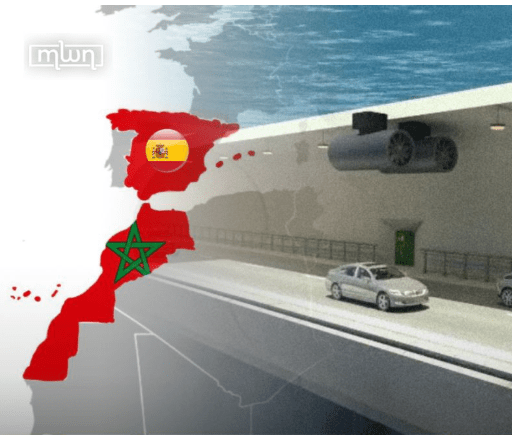
After decades of delays, the long-envisioned tunnel connecting Spain and Morocco under the Strait of Gibraltar is once again gaining traction. If completed, this ambitious infrastructure project will not only set engineering records but also become a transformative link between two continents.
Project Overview: A Tunnel of Global Scale
Planned to stretch 60 kilometers, including 28 kilometers beneath the sea, the Gibraltar Tunnel could surpass the Eurotunnel and Japan’s Seikan Tunnel to become the longest underwater rail connection in the world. The route will connect Algeciras in Spain to Tangier in Morocco and is designed exclusively for rail traffic—both passengers and freight—with no vehicle access envisioned at this stage.
Timeline and Current Status
Spain’s public company Secegsa confirmed that two pivotal technical studies are underway:
- Geotechnical analysis of the Camarinal Sill, the submarine ridge where the tunnel would be bored.
- Seismic monitoring using specialized equipment to evaluate tectonic stability.
These studies are scheduled to conclude by September 2025. However, the project’s full completion is not expected before 2040 at the earliest. This extended timeline reflects the project’s complexity and the many technical and financial hurdles ahead.
This summary draws on details reported by La Razón in their recent article: https://www.larazon.es/internacional/cuando-estara-terminado-tunel-gibraltar-que-unira-marruecos-espana_2025033067e95c866990370001fd1977.html
Financial Scope and Investment
While early estimates placed the cost at €6 billion, more recent analyses suggest the figure could exceed €15 billion. Funding is expected to come from a tri-partite partnership among Spain, Morocco, and the European Union. Key allocations to date include:
- €100,000 in 2022
- €750,000 in 2023
- €4.7 million in 2024 (including EU funds)
The progressive increase in funding signals a stronger political and strategic commitment from both sides of the Mediterranean.
Why This Project Matters: Strategic and Economic Impact
Beyond engineering feats, the tunnel holds immense geopolitical significance:
- Continental integration: Strengthens physical links between Europe and Africa, supporting trade, logistics, and human mobility.
- Regional development: Boosts economic prospects in southern Spain and northern Morocco.
- Green transport shift: Prioritizing rail infrastructure aligns with EU climate objectives.
Technological Readiness Meets Political Momentum
Advances in tunneling, seismic insulation, and marine geotechnics are finally converging with a favorable diplomatic climate. Since 2023, Spain and Morocco have resumed high-level cooperation, and the tunnel has been integrated into the EU’s Recovery and Resilience Facility strategic priorities.
Conclusion: A Vision Worth Watching
While the 2040 target may seem distant, the Gibraltar Tunnel symbolizes a rare blend of visionary ambition and practical feasibility. For investors, planners, and financial modelers, this is a project worth monitoring closely.
For renewable energy and infrastructure professionals seeking to evaluate large-scale transport investments, mastering comprehensive financial modeling frameworks is crucial.
✅ Ready to dive deeper? Connect with Finteam for tailored financial advisory services in energy and infrastructure.
 Finteam