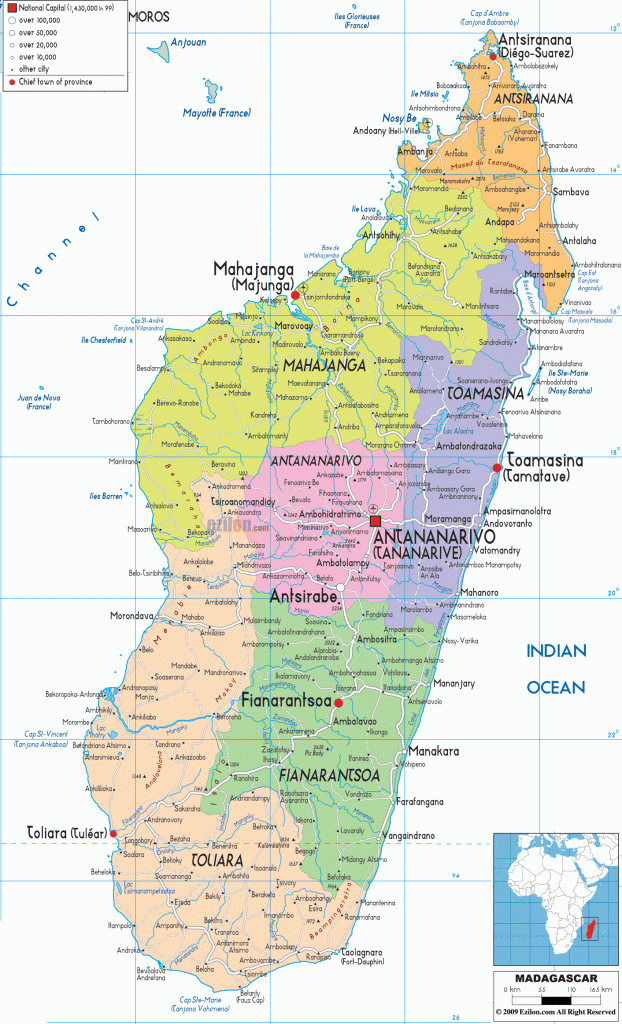
EDF Renewables formally joined the consortium overseeing the Volobe Amont hydroelectric project in Madagascar, marking a pivotal development for the country’s clean energy ambitions. This large-scale initiative exemplifies the growing role of financial modeling and international partnerships in making African renewable infrastructure bankable and scalable.
Consortium Structure and Ownership
The Volobe Amont project now comprises a robust consortium:
- EDF Renewables: 37.5%
- Axian Group: 37.5%
- Africa50: 25%
- Government of Madagascar: 20% (to be formalized at financial close)
This diversified ownership structure not only spreads the investment risk but also ensures a strong alignment between public and private sector stakeholders.
Institutional Support & De-risking Instruments
The project benefits from institutional backing from the IFC and the World Bank Group, crucial players in structuring concessional financing. These forms of support are vital in mitigating country risk and enabling favorable lending terms.
From a financial modeling perspective, this concessional finance—potentially including guarantees or low-interest loans—will significantly impact the weighted average cost of capital (WACC), making the project more attractive for debt and equity investors alike.
Capital Requirements and Modelling Considerations
A 2020 Infralogic report estimated the Volobe Amont project would require at least USD 500 million in capital expenditure. This figure demands:
- Detailed CAPEX/OPEX Forecasting: Precision in infrastructure and logistics assumptions.
- Power Purchase Agreement (PPA) Structuring: To secure long-term revenue certainty.
- Currency Risk Modeling: Especially relevant for Madagascar’s Ariary exposure.
- Sensitivity Analysis: Evaluating impacts of delays, cost overruns, or hydrological variability.
For financial modellers, stress-testing these variables ensures both the feasibility and bankability of the project under various scenarios.
Strategic Importance for Madagascar
Volobe Amont will play a critical role in improving energy access in Madagascar—a country where electrification remains below regional averages. Hydropower, with its low operating costs and long asset life, provides a stable backbone for national grids when properly financed and maintained.
Beyond energy security, the project is expected to catalyze job creation, infrastructure development, and local capacity building. For international investors, it represents a strategic opportunity to engage in sustainable, long-term African infrastructure with strong institutional support.
Bankability through Financial Modelling
This project is a textbook case for why financial modelling is indispensable in infrastructure development. Key steps include:
- Building comprehensive DCF models that integrate concessional funding flows.
- Assessing project IRR vs. equity IRR to ensure alignment among sponsors.
- Modeling the impact of government participation at financial close.
- Analyzing debt service coverage ratios (DSCR) to test loan viability.
Conclusion: A Template for Future IPPs in Africa
The Volobe Amont project represents more than just a hydro plant—it is a template for what successful Independent Power Producer (IPP) frameworks can look like in Africa. By leveraging consortium structures, concessional finance, and meticulous financial modeling, stakeholders are paving the way for scalable renewable energy solutions.
📩 Interested in modeling, structuring, or evaluating similar infrastructure projects? Contact Finteam to enhance your strategy with tailored financial insights.
 Finteam