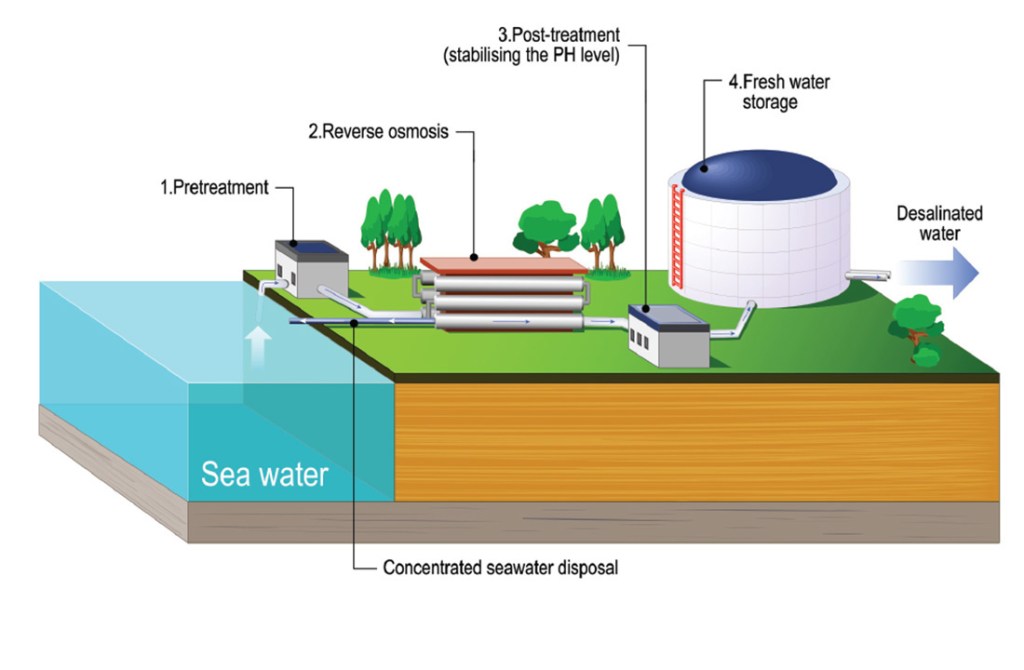
As water scarcity intensifies across the globe, large-scale desalination projects are emerging as strategic investments in national water resilience plans. For financial modellers, these projects pose unique challenges—high upfront capex, energy-intensive processes, long lifespans, and regulatory complexity. This article outlines a structured approach to desalination financial modelling, highlighting key assumptions, metrics, and stress factors, with reference to the Casablanca SWRO plant in Morocco where useful. 💦📈🛠️
1. Key Assumptions & Project Structure 💼🧮🌊
Start with defining:
- Capacity: Typically measured in m³/day (e.g., 300,000–800,000 m³/day).
- Technology: Reverse osmosis (RO) dominates due to cost and energy efficiency.
- Phased Rollouts: Break models into construction and commissioning phases.
- Useful Life: 25–30 years with major maintenance every 10–15 years.
- Offtake Types: Municipal, industrial, and agricultural consumption mix.
Example: The Casablanca desalination plant in Morocco is designed in two phases, reaching 822,000 m³/day and supplying water to over 7.5 million people, with 50 million m³ allocated to agriculture. 🚰🔧📊
2. Capex & Financing Design 💰📉🏗️
Desalination capex includes pretreatment units, RO membranes, brine management, and pipelines. The financial model should include:
- Construction Schedule: Reflect phased build-out (e.g., Phase 1 by 2026, Phase 2 TBD).
- Transport Infrastructure: Storage, pumping stations, 100+ km pipelines.
- Financing Sources: Blend equity, senior debt, concessional loans, and grants.
- Benchmarks: Capex ~US$1,000–$1,500 per m³/day capacity.
Casablanca’s US$14.3 billion program includes US$301 million for water transport infrastructure and is delivered under a PPP model led by ACCIONA. 💼🏦💡
3. Revenue Modeling & Tariffs 📊💸📈
Revenue is derived from Water Purchase Agreements (WPAs) or usage-based tariffs:
- Municipal Tariffs: Often fixed with annual indexation.
- Agricultural Supply: Discounted or subsidized.
- Take-or-pay Clauses: Critical for debt structuring.
In Morocco, the tariff is set at 4.48 DH/m³ (~US$0.45). Model should forecast volumetric uptake, apply ramp-up curves post-commissioning, and consider escalation clauses. 💧📝📆
4. Operating Costs & Energy Use ⚙️🔋📉
Energy can account for 40–60% of opex. Consider:
- Power Source: On-site renewables vs grid power.
- Other Opex: Membrane replacement cycles, labor, chemicals.
- Automation: Fully automated systems reduce recurring costs.
The Casablanca facility will be 100% powered by renewables and is fully automated, lowering operating risk. 🌿💻🔌
5. Risk & Sensitivity Analysis 📉🧪🔍
Key sensitivities:
- Electricity Prices: Model LCOE for renewables vs grid.
- Capex Overruns: Apply 10–20% contingency.
- Currency Risk: FX mismatch between debt (USD/EUR) and revenues (local).
- Demand Volatility: Use drought and water scarcity scenarios.
Run Monte Carlo or tornado analyses on tariffs, costs, and construction timelines. 💥📊🧮
6. ESG & Regulatory Considerations 🌱📘⚖️
Desalination comes with environmental and regulatory constraints:
- Brine Discharge: Include costs of treatment and compliance.
- Carbon Footprint: Especially relevant for grid-powered plants.
- Regulatory Support: Long-term policy stability improves project bankability.
Morocco’s national water strategy aims to scale desal capacity from 9 to 20 plants by 2030, ensuring policy alignment for projects like Casablanca. 🌍💬📑
7. Outputs & Decision Tools 📊🖥️📉
A robust model delivers:
- Equity & Project IRRs
- NPV and LCOW (Levelized Cost of Water)
- DSCR profiles under base and stress cases
- Sensitivity dashboards for tariffs, opex, capex, and FX
For practical implementation, you can explore the Desalination Water Treatment Plant 10-Year Financial Model available on Eloquens: https://www.eloquens.com/tool/0aXLiwRa/finance/industry-specific-financial-models/desalination-water-treatment-plant-10-year-financial-model?ref=finteam 🧰📘💡
Conclusion 📌📈💧
Financial modelling for desalination projects is a technically layered exercise that integrates infrastructure engineering, tariff policy, ESG planning, and long-term risk analysis. The Casablanca SWRO plant, Africa’s largest, exemplifies the scale and sophistication required to build investment-grade water infrastructure. For modellers, ensuring the model captures dual-phase rollouts, renewable integration, and ESG compliance is critical to making desal projects bankable, scalable, and sustainable. 🌊🏗️📉
 Finteam