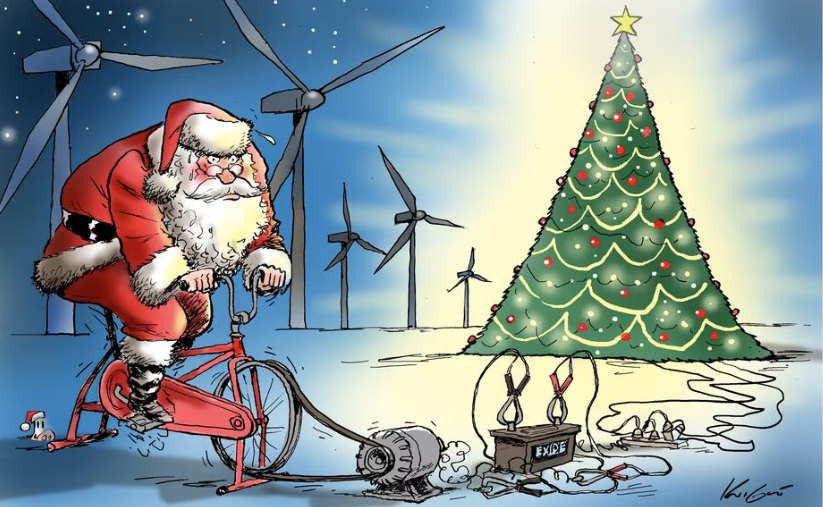
Christmas is not just a stress test for family dinners and airport security. For power systems, it is one of the most interesting — and volatile — periods of the year. Electric heating works overtime, Christmas lights turn cities into glowing postcards, and industrial demand briefly steps aside. The result? Sharp demand peaks, wild price swings, and a perfect playground for financial modellers. 🎄⚡📈
From an energy finance perspective, Christmas is essentially a compressed power market laboratory: everything that usually happens over a year is squeezed into a few cold, dark weeks. ❄️🧪⚡
The Christmas Load Curve: Not Your Average Day 🎅⚡🎄
Electricity demand around Christmas has a few quirks that system operators know all too well. 🎄👀⚡
• Strong evening peaks as households dominate consumption
• Lower industrial baseload due to holidays
• Extreme sensitivity to temperature (a cold snap can ruin everyone’s forecasts)
Across Europe — particularly in Germany, France, the Nordics and the UK — late-December demand can sit 5–10% above seasonal averages, while intraday price spreads widen noticeably. For financial modellers, this is a polite reminder that annual averages are lying to you. 🎅📊🤥
If your model only looks at yearly P50 prices, congratulations: you’ve just missed some of the most profitable hours of the year. 🎁⏰💸
How to Model Christmas Without Losing Your Sanity 📊🎄🤯
Christmas demand should not live in a classic 20-year project finance tab. It behaves more like a short-term trading model, usually built on: 🎄📉⚡
• Hourly (or sub-hourly) load forecasts
• Temperature-linked demand assumptions
• Day-ahead and intraday price curves
• Asset dispatch logic under tight grid conditions
Most modellers focus on long-term stability. Christmas does the opposite: it rewards precision, speed, and a healthy respect for chaos. 🎢🎯⚡
Batteries: Christmas Is Their Time to Shine 🔋✨🎄
If power markets had a favourite asset class in December, it would be grid-scale batteries. 🎅🔋⭐
Why? Because Christmas delivers exactly what batteries love: 🎁⚡📈
• Big evening peaks
• Wide price spreads
• Occasional grid stress and reserve activation
From a modelling perspective, the Christmas period often shows that a disproportionate share of annual battery revenues can be earned in just a handful of winter weeks. In merchant-heavy markets, it is not unusual to see 5–10% of yearly gross margin generated before New Year’s Eve. ❄️📊💰
Key assumptions to stress-test include 🧠📊🎄:
• Number of charge/discharge cycles per day
• Degradation costs from intensive cycling
• Peak price capture efficiency
• Ancillary services revenues when everyone else is on holiday
CHP and District Heating: Winter Cash Machines 🌱🔥🎄
Combined Heat and Power (CHP) plants and district heating networks quietly enjoy Christmas in a different way. Heat demand surges, electricity prices remain elevated, and the revenue stack suddenly looks very festive. 🎄🔥💸
Financially, this creates: 🎅📊💰
• Concentrated winter cash flows
• Strong EBITDA spikes in December–January
• Increased importance of fuel price pass-through
In some municipal systems, over a quarter of annual operating cash flow is generated during the winter peak. That makes liquidity modelling just as important as long-term profitability assumptions. ❄️🏙️📊
The Risks: Weather, Politics, and Human Behaviour ⚠️🌍🎄
Of course, Christmas modelling would be boring without a few risks. 🎅😅⚡
• A mild winter that kills the peak
• Grid maintenance colliding with holiday staffing
• Emergency regulatory interventions (price caps love bad timing)
• Behavioural surprises — travel patterns, remote work, or everyone buying the same electric heater
For lenders, these risks rarely threaten debt service. For equity investors, however, they define how much upside actually materialises. 🏦🎢💰
Why Christmas Actually Matters for Energy Finance 📊🚀🎄
Christmas demand modelling is not about festive curiosity. It is about identifying hidden optionality in flexible energy assets. Batteries, CHP, and hybrid systems often look very different once short-term volatility is properly captured. 🎁⚡🎯
The financial takeaway is simple. 🎅📘📊
• A few extreme days can drive annual returns
• High-resolution modelling unlocks real value
• Seasonality is not a footnote — it’s a revenue driver
As power systems become more renewable and less predictable, Christmas is no longer just a holiday. It’s a reminder that volatility, when modelled properly, can be extremely profitable. 🎄💸✨
 Finteam